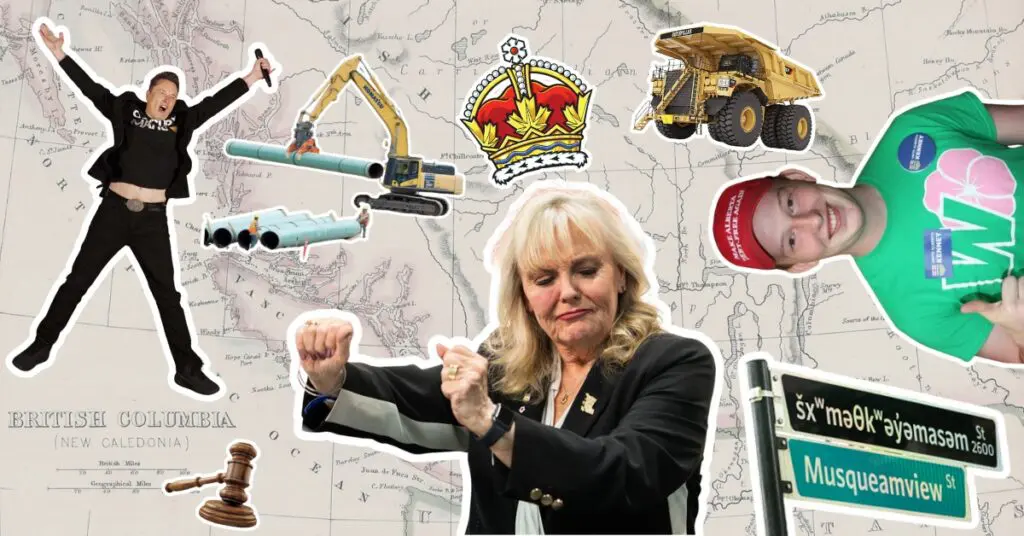
Who’s behind the backlash over Indigenous rights in B.C.?
B.C.’s 180-year old “land question” is fueling a very modern culture war. How did we get here?
The fake letter showed up on a family’s doorstep in Britannia Beach, warning the residents to leave their home and “remove all personal property, structures and improvements,” because the Squamish Nation was coming to take the land back.
The fraudulent document, which reads like it was generated by an AI chatbot, was signed with the name of Wilson Williams, chair of the Squamish Nation’s elected council. Williams quickly put out a statement calling it “100% false,” “blatantly damaging,” and a “deliberate provocation”.
The story made all the local newscasts, and spread quickly on social media. The First Nation reported the letter to police. A month later, it’s still a mystery who created the letter, and why. Was it a neighbourhood feud? A media hoax? Political dirty tricks? Foreign interference?
We don’t know. But whoever dropped off the letter must have known it would land like a spark in a tinderbox. Feelings of anti-Indigenous resentment have been cultivated for years by overlapping networks of activists in B.C. and beyond. Now, things are coming to a head.
Boosted by high-profile court battles, the backlash against Indigenous rights is shifting public opinion in B.C., shaping political outcomes and turning neighbours against each other. As the conflagration grows, it’s worth looking at who is putting fuel on the fire, and why.
Have you noticed the anti-Indigenous backlash in your B.C. community? Take our survey
How did we get here?
This culture war is the product of three interrelated campaigns that have built momentum over the last decade.
The first sprang up in response to the Truth and Reconciliation Commission’s final report in 2015, which found that Canada had committed “cultural genocide” against Indigenous peoples. Ever since, a network of right-wing think tanks has worked to justify, downplay or deny the impact of Indian Residential Schools, and undermine public sympathy for Indigenous rights.
The second is the response by powerful industries in B.C. to a series of Aboriginal rights wins. These include the 2014 Tŝilhqot’in title case, the Yahey cumulative impacts case in 2021, the Gitxaala Nation’s fight over mining claims, and the ongoing Cowichan case, which centres on a historic village site that was fraudulently sold to private buyers more than a century ago.
Finally, there’s the campaign by anti-Indigenous activists to win elected office in B.C., and use the legislature to change laws and roll back Indigenous rights. This effort started on the far right, but has moved into the mainstream with the election of BC Conservative leader Kerry-Lynne Findlay.
To be fair, racial hostility has been a feature of B.C. politics since the province was founded. In many ways, these modern campaigns represent a resurgence of much older forces, in reaction to a period of legal and social progress toward grappling with those wrongs of the past.
The high water mark was probably 2019, when B.C. lawmakers voted unanimously for the Declaration on the Rights of Indigenous Peoples Act. At that time, opponents of reconciliation were on the political fringe. But seven years later, British Columbians’ sense of economic security is crumbling. And people are looking for someone to blame.
The Atlas Network and the “Great Canadian hoax”
In 2015, Volume 4 of the Truth and Reconciliation Commission’s final report stated that “at least 3,200 children” died out of 150,000 who were forced to attend Indian Residential Schools. TRC chair Justice Murray Sinclair said in media interviews that the number was probably 6,000 or more, but poor record-keeping meant the exact number would never be known.
This was not a surprise in Indigenous communities, where to this day some elders who attended these institutions describe being forced to dig graves for other children. But many Canadians were stunned, disturbed, and forced to question the history of their own country.
The schools, the TRC found, were part of a system of “cultural genocide” intended to dismantle Indigenous languages and cultures, to facilitate the takeover of their land. The stark testimony of thousands of witnesses added weight to decades of Indigenous lawsuits, which have exposed the Crown’s shaky legal claims to much of the landbase – especially in B.C.
This sent a ripple of alarm through Canada’s network of libertarian and “free market” think tanks, which advocates for private property rights, deregulated resource extraction, and the legitimacy of a Canadian state founded on the European colonial occupation of North America.
The Frontier Centre for Public Policy began a pushback campaign that has produced hundreds of opinion articles attempting to downplay, justify or outright deny deaths at residential schools. The think tank has slowly ramped up its rhetoric over the last decade, running radio ads, writing speeches and promoting books purporting to expose “the Great Canadian Hoax”.
The Frontier Centre is part of the U.S.-based Atlas Network, which offers training, funding and coordination to more than 500 right-wing think tanks around the globe. Its partners include the Fraser Institute, Canadian Taxpayers Federation, MacDonald-Laurier Institute and more.
The campaign took on greater urgency after 2021, when ground-penetrating radar revealed anomalies that suggested burials at the site of the Kamloops Indian Residential School. Soon, First Nations across the country reported similar findings, and in one case, physical remains.
A fierce debate continues over whether and how to excavate these sites. If they are indeed the unmarked graves of children, some residential school survivors want them left undisturbed. But that leaves the Frontier Centre and Fraser Institute to claim there are no graves at all.
While the Frontier Centre takes a more strident tone than some of its network partners, it is far from fringe. Its “senior fellows” include retired Calgary professor Tom Flanagan, one of the architects of Prime Minister Stephen Harper’s rise to power. Harper’s successor, Pierre Poilievre, gave a speech at the Frontier Centre in 2023.
The Atlas Network-backed campaign to create doubt around deaths at residential schools has gone mainstream. And it has fueled a culture war that diverts attention from the underlying question: whose land are we living on? And who should decide what happens on that land?
The real threat to private property
The Gold Fields Act of 1859 attempted to answer that question, before British Columbia even became a province. Positioning mining as the highest and best use of land in the colony, it gave any man holding a Free Miner’s Certificate the legal right to enter and stake a claim to land, pretty much anywhere.
These days Free Miners can be transnational corporations, and claim staking can be done online, by anyone with a credit card. But it is still true that a mining company can enter private property and start digging without consent from the landowner, same as on Indigenous lands.
Carolyn and Warren Bepple found that out the hard way, when their 40-acre family farm near Kamloops was staked by a company looking for diatomaceous earth. The Bepples lost their lawsuit and the company moved in and strip-mined their property, to make kitty litter.
It’s ironic that the people fighting to maintain this Gold Rush-era status quo pretend that it’s First Nations who pose the greatest threat to private property. A pipeline company can build through your back yard, and use a Right of Entry order to access your property if you say no.
But this corporate supremacy has been challenged in the last 10 years, by a string of legal victories that threaten to balance the playing field between Indigenous titleholders and the global investors who control resource extraction in B.C.
The most direct challenge is posed by the Gitxaala case, which goes right to the heart of the Free Entry Mining regime, and has unleashed a counter-campaign by resource companies that see the implications of losing unfettered access to almost all land in B.C.
It’s not just the mining industry, although they’re the top dogs. Fracking and pipeline companies, loggers, cattle ranchers, guide outfitters and even small-scale tourism operators make their money by leasing access to specific parcels of so-called “Crown land”.
Resource companies put their foot down
What if that land is not actually the Crown’s to rent out? That’s what the Tŝilhqot’in proved in 2014, in a landmark title case that offered a powerful precedent to other nations seeking to prove collective ownership of their land.
That caused deep anxiety in some of the same people who are threatened by the widespread acceptance of the horrors of residential schools. The result has been a parallel campaign to ensure Indigenous communities don’t slow down resource extraction in B.C.
The corporations, the Crown and their lawyers have spent much of the last decade battling Indigenous rights claims in the courts, and losing. This has led to the conclusion that they need to change the underlying laws, so First Nations have less of a legal foothold to deny consent or assert jurisdiction over land.
Many of the same Atlas Network members have now taken up a campaign to repeal the Declaration on the Rights of Indigenous Peoples Act, or DRIPA, to “help spur mining investment,” in the words of the Fraser Institute. But some on the right go farther, calling to reopen Canada’s constitution.
Alberta’s Danielle Smith is trying to build a coalition of premiers to amend Section 35, which recognizes Aboriginal rights. BC Conservative leader Kerry-Lynne Findlay, who wants to create a “Western Alliance” with Smith, says she would seek amendments “to ensure that property rights take primacy and are constitutionally protected”.
That’s exactly what the Frontier Centre for Public Policy has been advocating for: U.S.-style constitutional protections for private land ownership, as a bulwark against Indigenous land claims.
B.C. politics lurches to the right
At times the recent BC Conservative race seemed to be a contest over who would be toughest on Indigenous rights. Kerry-Lynne Findlay accused Kamloops MLA Peter Milobar of “conflict of interest” because his wife is Indigenous. Milobar shot back: “How is that a conflict of interest? I’ve been voting against lots of Indigenous issues.”
Then Findlay herself came under attack from Caroline Elliott, who pointed out that Findlay was party whip for the federal Conservatives in 2022, when Parliament unanimously adopted a motion recognizing Canada’s Indian Residential Schools as part of a genocide. Findlay disavowed the motion, and denied that she encouraged Conservatives to vote for it.
Elliott nearly won the race, after making her campaign all about fighting Indigenous rights. She finished with 49 per cent to Findlay’s 51, but managed to focus the entire party, and its new leader, on her signature issue. Elliott says she is now considering a run for MLA.
If she wins, she will join two politicians who have built thriving online careers whipping up scorn and resentment toward Indigenous people: Dallas Brodie and Tara Armstrong. Both were elected as BC Conservatives, but left early last year.
Brodie was ejected from the caucus by former leader John Rustad after mocking residential school survivors on a podcast. Reading her social media posts, it is clear she has been marinating for a long time in Atlas Network talking points about residential schools.
Tara Armstrong quit in solidarity, then joined with Brodie to form the One BC party a year ago. She parted ways with Brodie in December, only to become an even more extreme voice. During a debate over K’ómoks treaty legislation, Armstrong claimed that the treaty promotes a “blood and soil theory” of Indigenous rights, comparing it to Nazi racial ideology.
When other politicians expressed shock, Armstrong doubled down, posting a video to social media repeating the phrase. Like Brodie, Armstrong knows how to use her platform as a lawmaker to generate controversial content that will explode on social media.
Whether either of them can get re-elected is perhaps beside the point. What they are doing is opening up space on the right for other politicians to step into. They test the waters, they push the envelope, and they pull the entire political field with them. Kerry-Lynne Findlay is now the BC Conservative leader, and if current polling holds, the premier in waiting.
Meanwhile the BC NDP premier has turned his back on Indigenous leaders, complained publicly about judges’ decisions, and tried desperately to wriggle out of the DRIPA legislation that his party introduced a few short years ago. By chasing the conservatives to the right, he has revealed a lack of principles, alienated traditional allies, and tanked his own approval numbers.
The culture war heats up
This leaves the B.C. government weaker and less legitimate than ever, right when the metastasizing culture war over Indigenous rights demands strong leadership.
Because while think tanks, lawyers and politicians debate dry, procedural matters like censure motions and constitutional amendments in the mainstream media, a completely different discussion is unfolding on social media, and hard-right infotainment channels.
The temporary closure of Joffre Lakes provincial park. The eviction of trailer park residents in Comox. The renaming of streets and schools. The fight over docks on the Sunshine Coast. The Land Act controversy. The Haida title agreement. It seems like every week, the anchors on Juno News, Rebel News and a hundred lo-fi copycats have new reasons to light their hair on fire.
Most British Columbians are not getting their news from Global, CTV or CBC. They’re getting opinions on Facebook, Tiktok or X, usually from people with an axe to grind. And these agitators and amplifiers have struck a rich vein, with a topic that taps into deep-seated fears about decolonization.
So far this content is mostly circulating within Canada. But there are signs it is breaking containment. In April, Elon Musk mockingly shared a video of NDP MP Leah Gazan using an awkwardly long acronym to raise the alarm about budget cuts to Indigenous communities.
Musk’s caption was “Canada is cooked”. The clip of Gazan was soon picked up by other right-wing figures like Ted Cruz and Matt Walsh, and then featured in a segment on Fox News. The world’s richest man, and millions of his online acolytes, are clearly watching what unfolds in Canada.
Local right-wing news outlets and social media influencers now have incentive to find a story they can package up, in just the perfect way, to get a cry-laugh emoji or a “concerning” out of Elon Musk. We could be one X post away from becoming the focus of the whole global MAGA outrage factory.
“Landback” is not a metaphor
It was never going to pass unnoticed that a Canadian province forgot to get receipts for 95 per cent of the landbase that it claims. British Columbia has been fudging the land question for 180 years, ever since the Oregon Treaty of 1846. And like that earlier negotiation with the Americans, the current reckoning has deep implications for U.S. interests.
American billionaires own millions of acres of farmland in B.C. They control the only oil refinery on Canada’s West Coast. They own the only gas pipeline to the coast. They own the Ksi Lisims LNG proposal. The American government, companies and wealthy citizens own critical minerals mines, sawmills, warehouses, businesses and luxury real estate all over B.C.
Elon Musk himself flew into a private hot spring resort last summer, near Bella Coola. The question of who owns the land in B.C. is not just of interest to homeowners in Richmond, or think tank guys in Winnipeg. It could affect the investments of some of the wealthiest and most powerful people in the world.
Their anxieties are not entirely unfounded. Although Indigenous land claims have been careful over the years to focus on “Crown land,” not private property, it was inevitable that some specific properties get swept up in lawsuits, due to the rampant criminality (illustrated by the Cowichan case) during the decades when much of the best land in B.C. was carved up.
The most likely solution, once the B.C. government’s appeal of the Cowichan is resolved, is for the Crown to pay some sort of compensation to the original owners for the theft of their land, while the current owners continue to hold fee simple title (the Cowichan Nation has made no claim against those private properties). We’ll see what the Supreme Court of Canada says.
Either way, greater Indigenous control over Crown lands is already proving to be make-or-break for high stakes resource extraction projects.
That’s why so many powerful people are paying attention to the ongoing lawsuits, and trying to enlist British Columbians in a wider backlash against Indigenous rights. But the truth is, more foreign-owned megaprojects are not the solution to our problems. We’ve been trying that for 180 years, and it’s landed us exactly where we are: vulnerable, precarious and broke.
It’s time to try something different. But first, we have to shake off the fear that’s been drilled into us over the last decade by a coalition of ideological think tanks, greedy billionaires, self-interested politicians and online provocateurs.
Help us track how anti-Indigenous backlash is showing up in B.C. communities: take our survey here.
